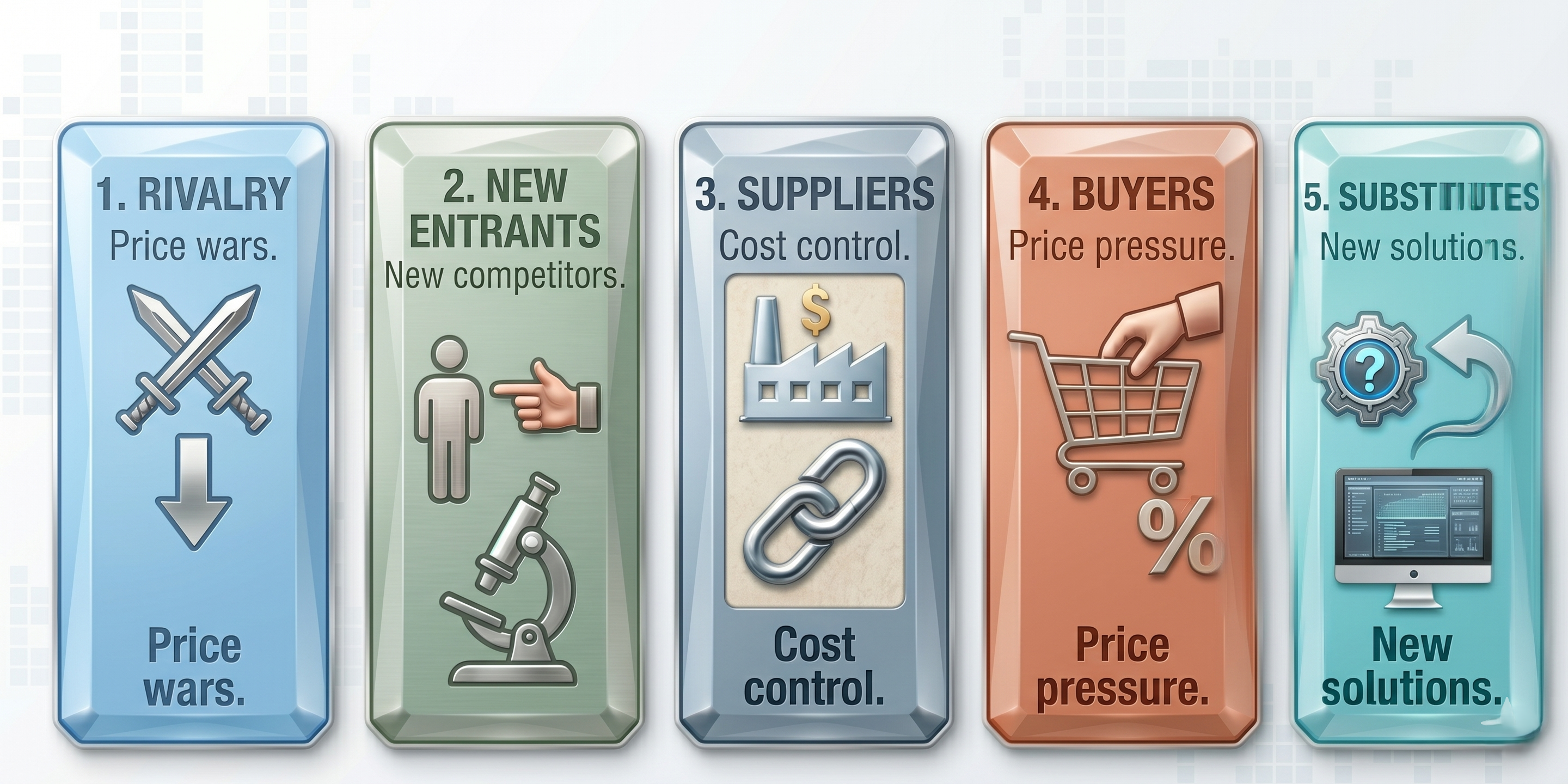
True innovation doesn’t start with ideas; it starts with understanding the landscape you operate in. While the legendary Peter Drucker taught us where to find the seeds of opportunity, Michael Porter, the preeminent Harvard Business School strategist, gave us the framework to understand the "weather" in which those seeds must grow. If you have ever wondered why some industries yield effortless profits while others feel like an uphill battle, the answer isn’t luck or timing.
It is the invisible gravity of The Five Forces. By analyzing these dynamics, you move beyond reactive management and begin positioning your business to win by design rather than by chance.
1. The Threat of New Entrants: Defending Your Territory
How easy is it for a hungry new rival to jump into your lane and steal your market share? In many digital-first industries, the "barrier to entry" has collapsed; if anyone with a laptop and a small budget can replicate your business model, your long-term profit margins are under constant siege.
True innovation in this category isn’t just about launching a better product; it`s about building a strategic moat. This could take the form of high capital requirements, proprietary technology, or deep-seated brand loyalty that makes switching too costly for a customer to consider a newcomer.
- The Micro-Audit: Are you currently relying on "first-mover advantage," or are you building a structural moat that makes it prohibitively expensive or difficult for new players to copy your success?
2. The Bargaining Power of Suppliers: Controlling Your Costs
Who really holds the steering wheel in your relationship with vendors? If your business relies on a specific software provider, a rare raw material, or a niche group of experts, those suppliers hold immense leverage over your bottom line.
When suppliers have the upper hand, they can raise prices or reduce quality at will, essentially "taxing" your hard-earned profits. To mitigate this force, high-performing businesses focus on diversifying their supply chains or innovating in ways that allow for material flexibility, ensuring they aren’t held hostage by a single point of failure.
- The Micro-Audit: If your primary supplier disappeared tomorrow or hiked their prices by 30%, does your business have a "Plan B," or would your operations come to a grinding halt?
3. The Bargaining Power of Buyers: The New Consumer Sovereignty
In the age of instant information, the "buyer" (your customer) has more power than at any point in history. With the ability to compare global prices in seconds and switch brands with a single click, customers can easily turn your product into a commodity.
When buyers hold the cards, they dictate the price, leaving you to fight for the scraps. To win here, your brand must move beyond "satisfactory" and offer a unique value proposition—a specific reason for existence that makes the price tag a secondary consideration to the solution you provide.
- The Micro-Audit: Does your brand offer a distinct emotional or functional "unique value" that makes your customers stop shopping on price and start shopping on relationship?
4. The Threat of Substitute Products: The Invisible Rival
The "substitute" is perhaps the most dangerous force because it is often the one you don’t see coming. A substitute isn’t a direct competitor selling the same thing; it’s a completely different way of solving the same underlying problem.
For example, Netflix didn’t just compete with the local video store; it acted as a substitute for the entire concept of "leaving the house for entertainment." If you only watch your direct competitors, you will be blindsided by the innovative alternative that makes your entire industry obsolete.
- The Micro-Audit: What are your customers doing to solve their problems instead of using your category of product? Are you watching the industry next door, or just the guy across the street?
5. Intensity of Rivalry: Breaking the "Race to the Bottom."
This is the "dog-eat-dog" factor that defines the daily grind of business. When an industry is crowded with players selling similar products, the inevitable result is a brutal price war and an expensive marketing arms race that drains everyone’s resources.
If you find yourself in a high-rivalry environment, your innovation strategy cannot simply be about being "better" or "cheaper." Instead, you must focus on radical differentiation. You have to find a "Blue Ocean" where the competition is irrelevant because you are playing a different game entirely.
- The Micro-Audit: Are you exhausted by trying to be the "best" (which is often a race to the bottom) or are you strategically positioning yourself to be the only one who does what you do?
Strategy is the Choice to be Different
Ultimately, strategy is the art of making hard choices. Understanding these five forces allows you to stop looking at your business in a vacuum and start seeing it as a ship in a complex ocean. As Michael Porter famously noted, "The essence of strategy is choosing what not to do." By identifying which force is putting the most pressure on your growth, you can stop fighting fires and start building a fortress.
Which of these five forces is putting the most pressure on your business right now?