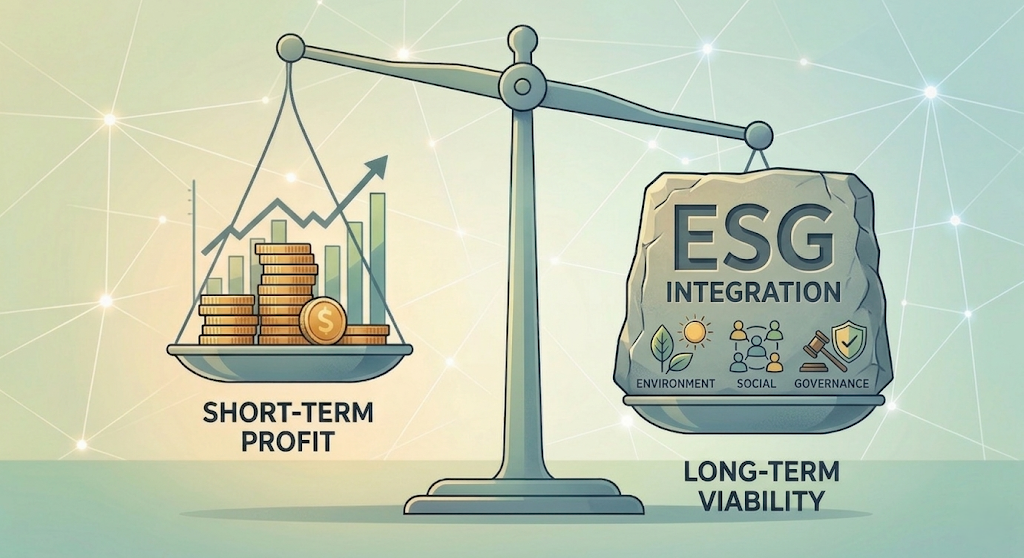
ESG has been highly visible for years, just not where it actually matters.
It shows up in reports, commitments, and messaging, but when real decisions are made, it’s often left out of the room. That’s what’s starting to change, and it’s a much bigger shift than it might seem at first glance.
From Visibility to Integration
This isn’t about redefining ESG. It’s about repositioning it, from something organizations communicate to something they actually use. And once that happens, ESG stops being abstract and starts creating real tension inside the business.
Where ESG Becomes Real
Because the reality is, not everything aligns. Short-term performance doesn’t always support long-term impact. Efficiency doesn’t always align with responsibility. Growth doesn’t always come with accountability. These aren’t theoretical dilemmas; they show up in everyday decisions about what gets approved, what gets delayed, and what doesn’t move forward at all.
That’s where most ESG efforts start to struggle.
It’s relatively easy to define commitments and publish them. It’s much harder to stand by those commitments when there’s a real cost attached. That’s the difference between visibility and integration.
What Integration Actually Changes
When ESG is truly integrated, it becomes part of how organizations define value, not just in financial terms, but in terms of long-term viability. It starts influencing how risks are assessed, how opportunities are evaluated, and how success is measured. Over time, it also changes the tone of leadership conversations. ESG is no longer a separate topic; it has become part of how decisions are framed in the first place.
But that kind of integration doesn’t happen automatically.
Some organizations treat ESG as a branding exercise. Others reduce it to compliance. In both cases, it remains disconnected from real decision-making. And that gap is becoming harder to ignore.
The Moment ESG Gets Tested
Stakeholders are paying closer attention not just to what companies say but to how consistently they act when trade-offs arise. That’s where credibility is built, or lost.
Because ESG isn’t really tested when it’s easy. It’s tested when it’s inconvenient, when it requires a different decision than the one you would have made otherwise. That’s also the point where many strategies begin to break down.
Which is why ESG integration isn’t about adding another layer to strategy. It’s about redefining how strategy works in practice. Not as a balance between profit and responsibility, but as a system where the two are increasingly connected.
That shift isn’t simple, but it is becoming unavoidable.
What’s your perspective?
Is ESG shaping real decisions where you work, or is it still mostly shaping how the organization presents itself?