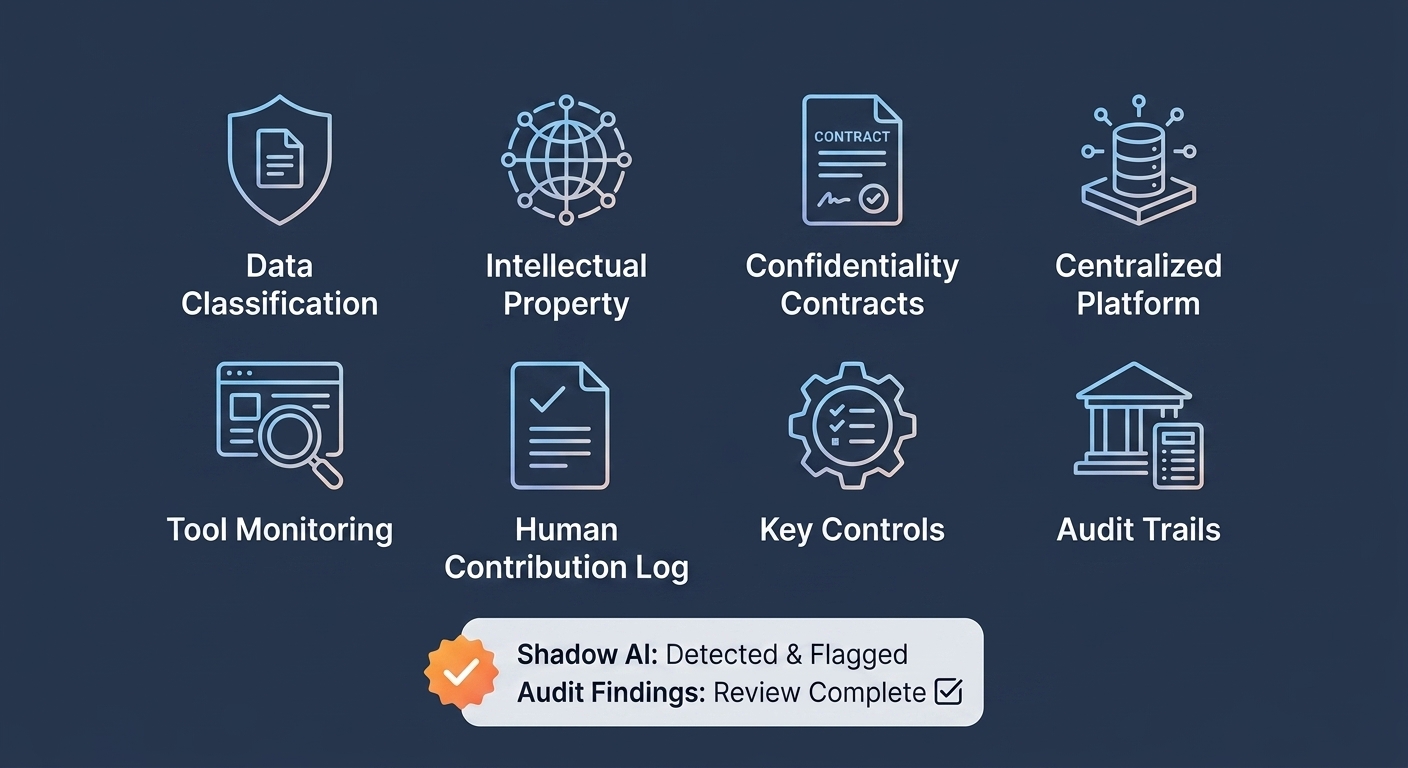
AI is already inside your innovation pipeline, whether anyone approved it or not. 93% of employees admit to feeding company information into AI tools without approval; AI still can’t be named as a patent inventor, and only 21% of companies have a mature governance framework for any of it. The fix isn’t another policy memo. It’s a four-step model you can actually run: tiered data classification, human contribution documentation, enterprise AI agreements, and centralized governance.
Knowing the model and running it are two different things. This is the checklist version: something you can sit down with this week, not a framework you nod along to and forget by Friday. Go tier by tier. Every unchecked box is a place your IP is currently exposed.
Step 1: Tiered data classification for AI inputs
Not all innovation data carries the same risk. Sort it before you decide what any AI tool is allowed to touch.
- Write down your three data tiers: core formulations and unreleased concepts, proprietary consumer research, and publicly available trend data.
- List every AI tool currently in use across your innovation team - approved and unofficial.
- Match each tool to the tiers it actually touches, not the tiers it’s supposed to touch.
- Flag any tool processing Tier 1 data without a signed data agreement covering that use. That’s your top exposure this week.
Step 2: Human contribution documentation
If you can’t show which choices a person made, you may not be able to show the invention is yours. USPTO guidance points squarely at version control.
- Add a "human contribution log" field to your idea intake workflow: prompts given, options generated, choices made.
- Confirm every active AI-assisted concept has a retained version history, not just a final output.
- Pick one live project right now and audit it for a documentation gap. If you find one, assume it’s not the only one.
- Assign an owner for this log. "Everyone’s responsibility" means no one’s.
Step 3: Enterprise AI agreements with real teeth
An acceptable-use policy is guidance. A contract is enforceable. Trade secret protection depends on the second one.
- Pull the actual contracts for every AI tool on your Step 1 list - not the marketing page, the legal terms.
- Confirm each includes explicit confidentiality and no-training-use provisions for your data.
- Identify any tool being used under a personal or free-tier account instead of the enterprise agreement - this is where shadow AI hides.
- Route anything that fails this check to procurement or legal before it touches another concept.
Step 4: Centralized innovation management as the governance layer
Governance that lives in five disconnected systems isn’t governance; it’s paperwork. This step is what makes Steps 1-3 auditable instead of aspirational.
- Map every system an idea passes through from first spark to launch.
- Mark which of those systems sit outside your central platform’s access controls and audit trail.
- Set a real date to route those outliers through one system - not "eventually," a date on a calendar.
- Re-run this whole checklist in 90 days. Governance is a cadence, not a one-time fix.
The four-step model isn’t a compliance exercise; it’s what lets your team keep moving fast on AI-assisted innovation without gambling the IP that makes the innovation worth protecting in the first place. Innovation Cloud builds this governance into the platform itself - structured idea capture, documented human-contribution workflows, and portfolio-level audit trails - so the checklist above stops being a quarterly fire drill and becomes the default way ideas move through your pipeline.
Score yourself. If you left more than four boxes unchecked, your exposure is closer to the 79% of companies without mature governance than the 21% that have it. The gap is now documented - which is exactly the audit trail a future dispute would ask for.