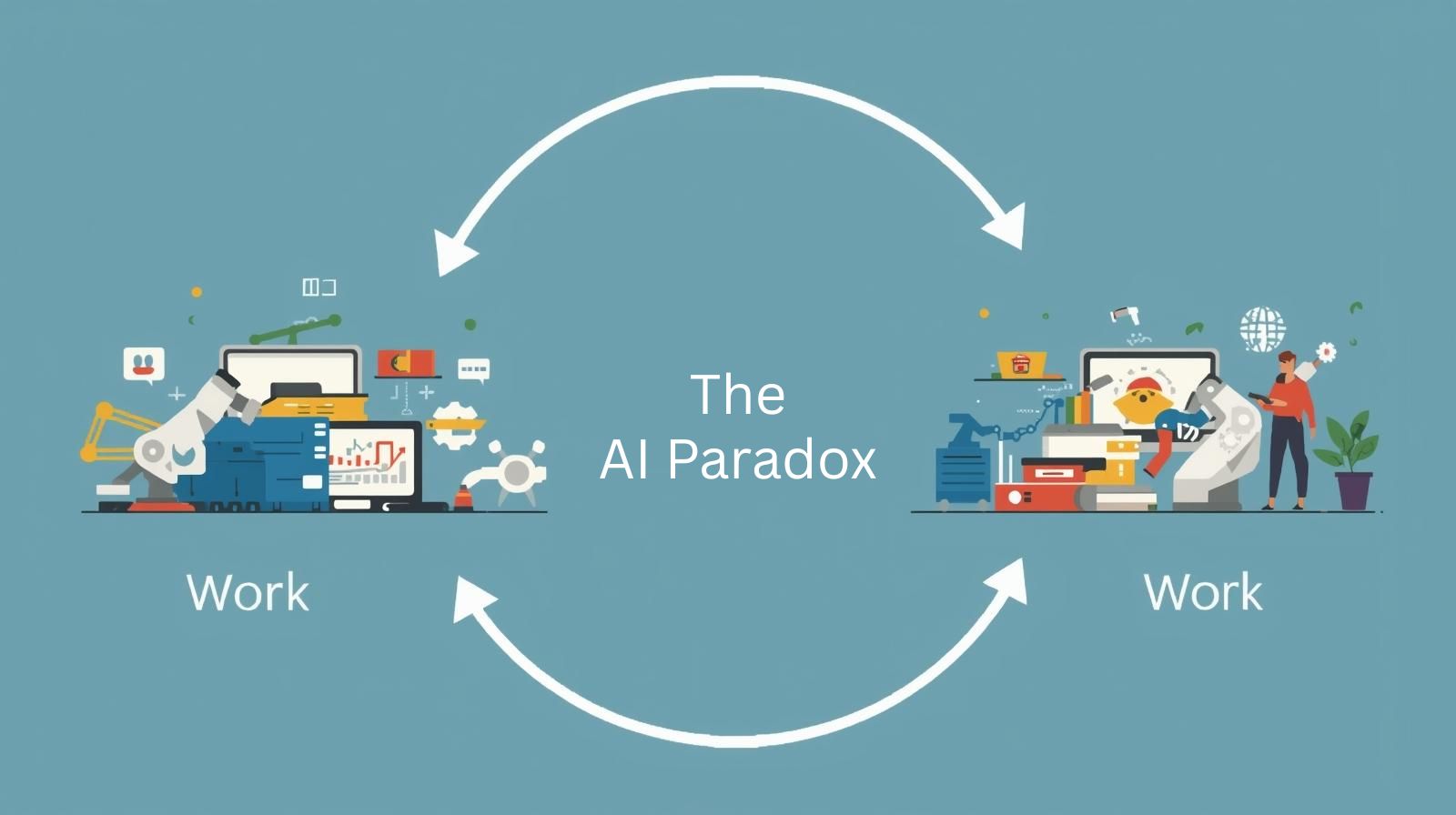
For every major technological shift, the same fear resurfaces: that efficiency will reduce the need for people. AI has amplified this concern, but history tells a different story.
AI is not primarily a labor-saving technology. It is a demand-creating technology.
When the cost of doing something drops dramatically, organizations don’t do less of it. They do more. Entirely new use cases become viable, experiments that once felt unjustifiable suddenly make sense, and work that never existed before comes into scope.
This pattern was first articulated in the 19th century by English economist William Stanley Jevons, who observed that efficiency gains in coal usage led not to reduced consumption, but to increased demand. Efficiency expanded possibilities rather than constraining them.
The same dynamic has repeated itself throughout the history of computing.
Mainframes were rare and accessible only to the largest organizations. Minicomputers expanded access. Personal computers multiplied it. Cloud software eliminated many of the structural advantages large enterprises once held. Each wave didn’t reduce work; it democratized participation and ambition.
What makes AI different is where this pattern now applies.
For decades, technology focused on automating deterministic work, tasks with clear rules and predictable outcomes. Accounting systems, CRM platforms, communication tools, and enterprise software made execution cheaper and more scalable across nearly every industry.
But non-deterministic knowledge work remained expensive. Research, strategy, writing, design, legal analysis, software creation, and advanced decision-making required specialized talent, time, and capital. Large enterprises could absorb those costs. Most organizations could not.
AI changes that equation.
AI agents dramatically lower the cost of engaging in knowledge work. Not by fully replacing humans, but by making exploration, iteration, and experimentation economically viable for far more teams and individuals.
This reframes how we should think about ROI. The biggest shift isn’t higher returns, it’s lower barriers to investment. When the cost of trying approaches zero, organizations do far more trying. More initiatives get started. More ideas are tested. More work is created.
This doesn’t eliminate the need for human judgment. It increases it.
AI outputs still require context, oversight, and integration into broader workflows. As models improve, expectations rise. Jobs don’t disappear; they decompose into tasks, recombine into new roles, and evolve around managing complexity rather than executing instructions.
We’ve seen this before.
As tools made marketing more efficient, the field didn’t shrink; it expanded. Lower costs enabled more companies to participate, launch more campaigns, and create more specialized roles. Technology didn’t replace marketers. It multiplied them.
AI will have a similar impact across various domains.
As Aaron Levie, Box CEO, has noted, AI will create more jobs than it replaces, not despite automation, but because of it.
The real disruption of AI isn’t efficiency.
It’s permission.
Permission to try what was once too expensive. Permission to explore what once required scale. Permission to do work that never existed before.
The future of work won’t be smaller.
It will be broader.