Most companies track costs. Very few track how much time they lose waiting to make decisions. That gap has a name: Decision Latency.
While most organizations obsess over Time to Market, the real bottleneck is rarely the engineering or the design. It is the time spent waiting for a signature, the three-week delay for a steering committee meeting, and the circular debates over data that is already out of date. In 2026, the competitive advantage has shifted from who has the most resources to who can achieve the highest Velocity of Certainty.
The "Zombie Project" Epidemic
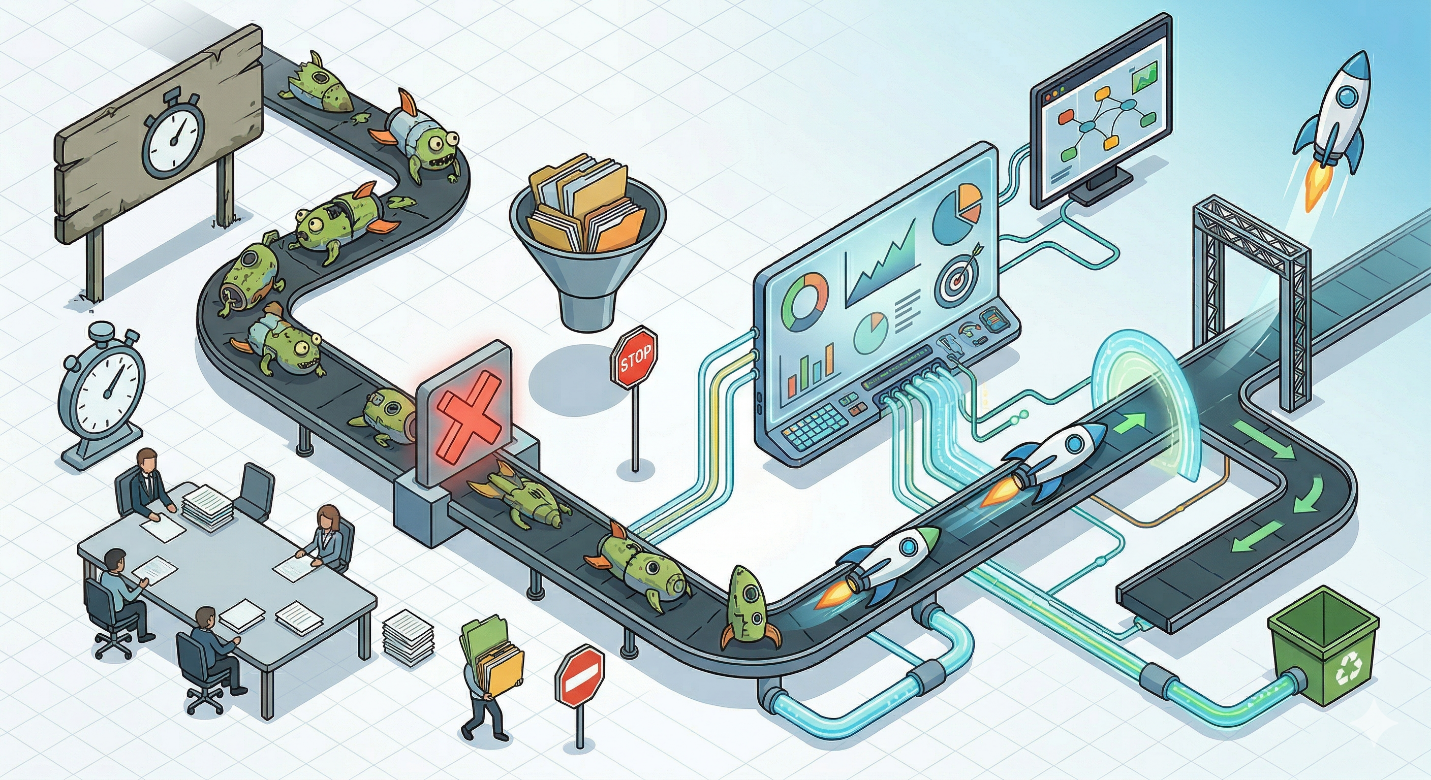
A fascinating, if sobering, industry statistic suggests that nearly 40% of the average R&D budget is currently tied up in Zombie Projects- initiatives that aren’t quite succeeding but haven’t been killed because the governance process is too sluggish to pull the plug.
The primary cause? A lack of real-time visibility. When decision-makers are forced to rely on Status Update Slides compiled manually over forty-eight hours, they aren’t making strategic choices; they are performing forensic audits. By the time a leader identifies a red flag, the team has already spent another month’s worth of burn rate.
The goal of optimization isn’t just to move faster; it’s to fail faster where necessary, so capital can be redeployed to the winners.
Rethinking the Gate: From Guardrails to Launchpads
Traditionally, the Phase-Gat" process was designed to be a filter- a series of rigid hurdles to stop bad ideas. However, in today’s hyper-accelerated market, these gates often act as roadblocks. Top-performing organizations are now pivoting toward Dynamic Governance.
The twist? The most efficient gates aren’t actually meetings. They are automated data thresholds.
Imagine a system where a project automatically triggers its own Go/No-Go review based on live market signals and development milestones. Instead of a monthly meeting where everyone catches up on what happened three weeks ago, decision-makers are alerted only when a project deviates from its predicted trajectory. This moves management from Micro-managing the Process to Managing by Exception.
The Hidden Tax of Manual Reporting
There is a profound irony in hiring elite talent to build the future, only to have them spend 20% of their week formatting spreadsheets for a leadership review. This Innovation Tax is more than just a waste of payroll; it is a morale killer.
True process optimization happens when the reporting is a by-product of the work, not an additional task. When the end-to-end innovation platform serves as the actual workspace, the data flows upward automatically. Decision-makers gain a God’s-eye view of the entire portfolio, seeing exactly where resources are bottlenecked and where the gates are getting stuck.
From Bottleneck to Catalyst
Optimization is often misunderstood as simply cutting costs. In reality, for a decision-maker, optimization is about reclaiming time.
When you eliminate the friction of manual data consolidation and replace update meetings with alignment sessions, you transform the role of the leader. You move from being a bottleneck, the person everyone is waiting on, to being the catalyst that clears the path for the next big breakthrough.
The companies winning in 2026 aren’t the ones with the most meetings; they are the ones who have built a system that makes the right decisions obvious, immediate, and data-backed. It’s time to stop managing the bureaucracy and start managing the breakthroughs.