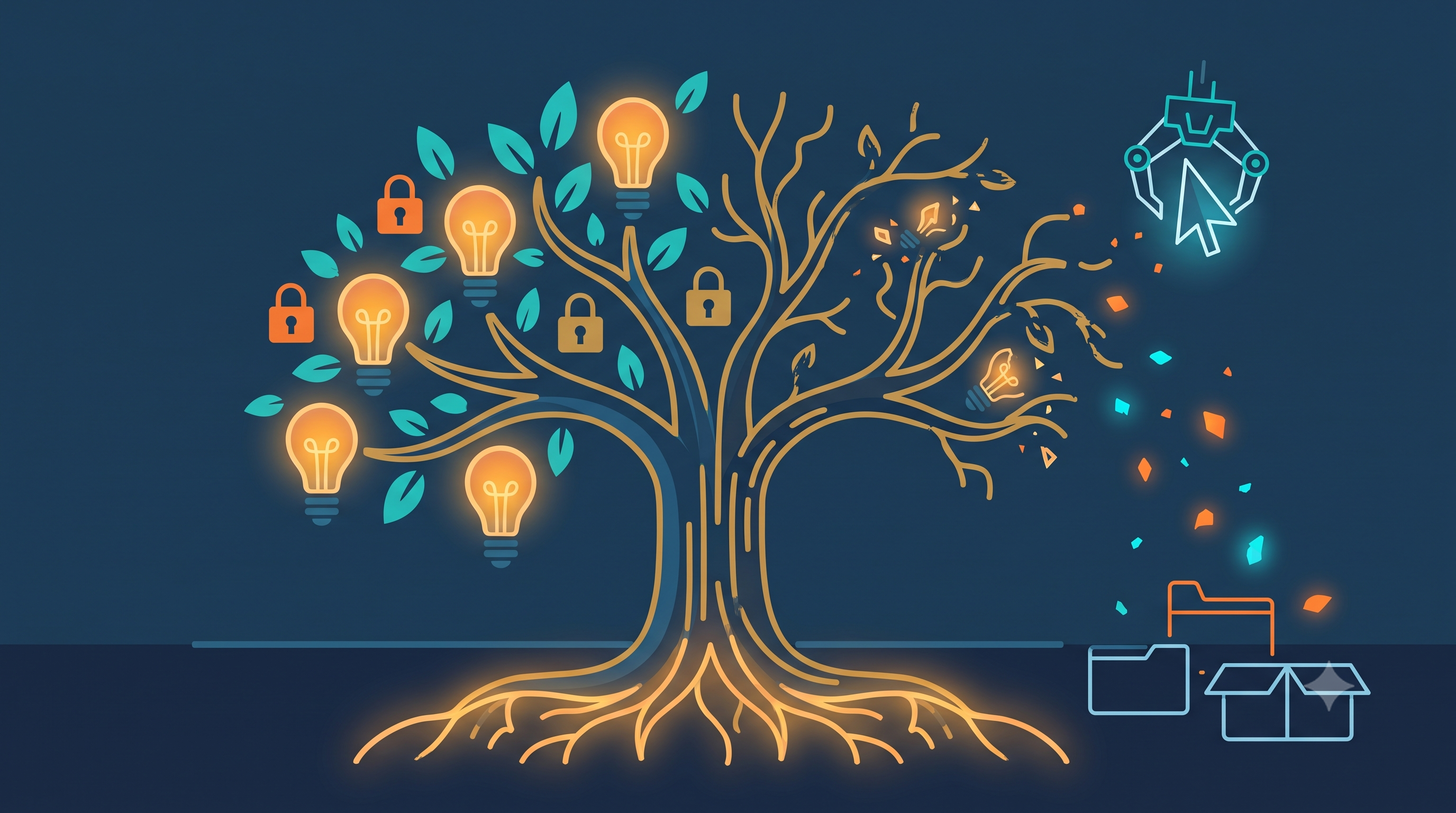
Your innovation team is using AI. Of course they are. Trend scanning tools. Concept generators. Formulation assistants. AI-powered competitive analysis. The productivity gains are real, the speed is real, and the quality of output is often genuinely impressive.
But here is the question most companies have not asked yet: when an AI agent contributes to your next breakthrough product concept, who actually owns what comes out?
This is not a philosophical question. It is a legal one, a strategic one, and in 2026 - as autonomous AI systems become embedded in R&D workflows across every major industry - it is an operational one that is already generating litigation, regulatory exposure, and competitive vulnerability for companies that have not thought it through.
The innovation sovereignty question has arrived. And the organizations that do not have a structured answer are already at risk.
The Legal Ground Has Already Shifted - Twice
Most companies assume the law on AI and intellectual property is still being figured out. In some respects it is. But on the most critical question for innovation teams - who can be named as an inventor - the legal position is now clearer than many realize, and it has moved decisively in the past 12 months.
In November 2025, the USPTO issued its Revised Inventorship Guidance for AI-Assisted Inventions, rescinding the 2024 guidance and reaffirming a single foundational principle: only natural persons can be inventors under U.S. patent law, regardless of how significant AI’s contribution to the invention was. The revised guidance explicitly treats AI as a tool - comparable to laboratory equipment or research databases - not as a co-inventor or collaborator.
The European Patent Office reached the same conclusion through the long-running DABUS litigation. Germany’s Federal Court of Justice confirmed it. The UK Supreme Court confirmed it. The position is now consistent across every major patent jurisdiction: AI cannot be named as an inventor. South Africa is the only outlier, and legal commentators consider that decision to have minimal precedential weight.
The USPTO now treats AI the same as a microscope or a search engine. If your innovation process does not reflect that - your patents might not either.
What the law does not resolve - and what creates the real strategic risk - is what happens when the conditions for patent protection are quietly eroded before anyone files anything. That is where the danger lives for most companies.
The Silent IP Leak That Is Already Happening in Your Organization
The most immediate threat to innovation IP is not a competitor filing a patent on your idea. It is your own employees, using AI tools that were never designed to keep secrets.
The numbers are stark. According to ManageEngine’s 2025 research, 93% of employees admit to inputting information into AI tools without company approval. Of those: 32% have entered confidential client data into unapproved AI platforms, 37% have shared private internal company data through unauthorized tools, and 53% use personal devices for work-related AI tasks - creating exposure that IT teams cannot monitor, let alone control.
A 2025-2026 LayerX Security analysis found that 77% of employees paste data directly into generative AI tools, with more than 50% of those paste events containing corporate information. The average employee performs 6.8 pastes per day into AI tools, 3.8 of which contain sensitive data. And 82% of those pastes happen through personal, unmanaged accounts that bypass enterprise controls entirely.
93% of employees are already inputting company data into unauthorized AI tools. Your innovation pipeline’s most sensitive ideas may already have left the building.
The Samsung incident is the most visible example of what this looks like in practice. Engineers from Samsung’s semiconductor division inadvertently leaked confidential source code, meeting notes, and hardware specifications through ChatGPT while seeking debugging help. Samsung responded by banning generative AI tools on company devices entirely - an overreaction that is both understandable and commercially unsustainable.
The less visible version of this happens in innovation teams every day. A product manager pastes a concept brief into an AI summarization tool. A formulation scientist uses a public AI assistant to explore ingredient combinations. A trend analyst uploads a proprietary market research dataset for faster processing. Each act is individually well-intentioned. Cumulatively, they represent a structural exposure that most companies have not measured, let alone managed.
The Case That Changed the Rules: Trinidad v. OpenAI
The legal consequences of AI-assisted IP leakage are no longer theoretical. In a landmark January 2026 decision from the Northern District of California, the court dismissed a plaintiff’s trade secret claims under the Defend Trade Secrets Act because she had developed her alleged trade secrets through ChatGPT - meaning she had voluntarily disclosed them to OpenAI without establishing any confidentiality protections.
The court applied the principle that when a party discloses trade secret information to others who are under no obligation to protect its confidentiality, the property right is extinguished. The act of using a public AI platform - without a confidentiality agreement covering that platform’s data practices - was treated as voluntary public disclosure.
The implications for innovation teams are direct. If your R&D team is developing concepts, formulations, or product architectures using third-party AI tools without enterprise-grade data agreements in place, the ideas they generate may not qualify as trade secrets. Not because a competitor stole them. Because your own process exposed them.
Developing your next product concept through an uncontrolled AI tool is legally closer to posting it on the internet than filing it under trade secret protection.
A companion case, United States v. Heppner, reinforced the point from a different angle: the court held that documents created using publicly available generative AI are not protected by attorney-client privilege, in part because communications memorialized through an AI platform are not confidential when the platform is not contractually bound to keep them secret.
What Human-AI Collaboration Actually Means for Patent Strategy
The USPTO’s November 2025 guidance draws a critical line that every innovation team needs to understand. For a patent to be valid on an AI-assisted invention, a human inventor must have made a significant contribution to the conception of the invention - not just the research goal, but the specific solution.
This distinction is more operationally complex than it sounds. When an AI agent scans thousands of ingredient combinations and surfaces five candidates that meet a brief, and a human scientist then selects and refines one of those candidates - who conceived the invention? When an AI trend tool identifies a white space in a product category and proposes a concept that a human team then develops - where does AI assistance end and human invention begin?
The revised USPTO guidance suggests that selecting from AI-generated options, directing the AI’s inputs, or configuring the system for a specific task may constitute significant human contribution - but the burden of demonstrating this falls on the company filing the patent. And that demonstration requires documentation that most innovation workflows are not currently designed to produce.
Morgan Lewis’s analysis of the guidance is unambiguous: companies should maintain version control for AI-generated materials specifically to track how human inventors conceived, refined, selected, and integrated AI outputs. This means logging the prompts provided to AI tools, the choices made between AI-generated options, and the specific human contributions that shaped the final invention. Without that documentation, a patent on an AI-assisted invention is vulnerable.
The Governance Gap That Creates Competitive Vulnerability
Most companies understand, in the abstract, that AI governance matters. Few have built the specific governance model that innovation IP requires.
According to Deloitte’s January 2026 State of AI in the Enterprise survey, only 21% of leaders currently have a mature governance model for autonomous agents - even as those agents are being deployed in R&D workflows, concept generation, and product development pipelines. The gap between adoption and governance is not a technical problem. It is a structural one: innovation teams move fast, governance frameworks move slow, and the mismatch creates exposure.
The specific risks this creates in innovation management are threefold.
IP ownership ambiguity. Without clear documentation of the human contribution to AI-assisted ideas, companies cannot reliably establish inventorship for patent purposes or demonstrate the reasonable measures required to maintain trade secret protection.
Competitive intelligence leakage. Proprietary trend data, formulation databases, and innovation briefs fed into third-party AI tools may be incorporated into model training, potentially surfacing in competitors’ outputs. Troutman Pepper’s 2026 analysis warns that companies building or refining their own AI models face a distinct risk: if someone else’s confidential information ended up in their training data - even inadvertently - their model may have effectively absorbed a trade secret misappropriation claim.
Regulatory exposure. The EU AI Act’s phased enforcement, now fully active through 2026, imposes obligations on high-risk AI systems that include requirements around transparency, human oversight, and documentation of AI-assisted decisions. Innovation teams using AI in product development without governance frameworks may find themselves outside compliance without knowing it.
The companies that will own their AI-assisted innovations are not the ones moving fastest. They are the ones with governance systems that move at the same speed as their innovation teams.
Building Innovation Sovereignty: What the Best Companies Are Doing Now
The answer to the innovation sovereignty question is not to slow down AI adoption. It is to govern it properly. The companies building durable IP positions in the AI era are taking four specific steps.
Tiered data classification for AI inputs. Not all innovation data carries the same IP risk. Core formulations, unreleased product concepts, and proprietary consumer research are categorized differently from publicly available trend data and general market intelligence. Governance frameworks define clearly which categories can be processed by which AI tools, under what data agreements.
Human contribution documentation as a standard workflow step. Following the Morgan Lewis and USPTO guidance, leading innovation teams are building documentation checkpoints directly into their innovation management process: logging prompts provided to AI, recording the human choices made between AI-generated options, and maintaining an audit trail of how AI outputs were refined into inventions. This is not bureaucracy. It is patent defensibility.
Enterprise AI agreements with contractual confidentiality provisions. The legal exposure in Trinidad v. OpenAI arose because the plaintiff had no confidentiality agreement covering the AI platform she used. Enterprise AI procurement now requires explicit contractual terms governing data storage, training use, and confidentiality - not just acceptable use policies, but enforceable data processing agreements that establish the reasonable measures trade secret law requires.
Centralized innovation management as the governance layer. Shadow AI - employees using unauthorized tools outside sanctioned systems - is the most difficult exposure to control. Companies that route AI-assisted innovation activity through a centralized innovation management platform create the audit trail, access controls, and data governance that decentralized tool use cannot provide. The innovation management system becomes the accountability layer that makes AI adoption safe at speed.
The Bottom Line
The question of who owns your best ideas has always mattered. In the age of AI, it has become structurally more complex, legally more contested, and operationally more urgent than most innovation teams are prepared for.
The law has moved: AI cannot be a co-inventor, and ideas developed through uncontrolled AI tools may not qualify for trade secret protection. The risk is live: 93% of employees are already using unauthorized AI tools, and the courts have already ruled on what that means for IP protection. And the governance gap is wide: only 21% of companies have a mature model for managing autonomous agents in their workflows.
Innovation sovereignty - the ability to demonstrably own what your innovation system produces - is not a legal nicety. It is a competitive requirement. And like every other aspect of innovation discipline, it does not happen by accident. It requires process, structure, and a management system built to enforce both.
Innovation Cloud provides the centralized innovation management infrastructure companies need to govern AI-assisted innovation safely - from structured idea capture and documented human contribution workflows to portfolio governance and IP protection built into every stage of the process.
Schedule a demo: www.innovationcloud.com/page/demo-request.html
Sources
- USPTO, Revised Inventorship Guidance for AI-Assisted Inventions (November 28, 2025) - reaffirms only natural persons can be inventors under U.S. patent law
- Harris Law, Who Owns AI-Generated Inventions and Content in 2026? (April 2026) - international patent jurisdiction comparison
- Brownstein, USPTO Issues Revised Inventorship Guidance for AI-Assisted Inventions (December 2025) - analysis of November 2025 guidance
- Morgan Lewis, USPTO Issues Revised Inventorship Guidance for AI-Assisted Inventions (December 2025) - version control and documentation requirements
- Troutman Pepper Locke, Is Your AI Tool Quietly Destroying Your Trade Secrets? (May 2026) - AI tool trade secret exposure framework
- IPWatchdog, Navigating Recent Developments in Generative AI and Trade Secret Protection (April 2026) - Trinidad v. OpenAI and Heppner analysis
- ManageEngine / Kiteworks, 93% of Employees Share Confidential Data With Unauthorized AI Tools (August 2025) - shadow AI data exposure statistics
- LayerX Security / Usecure, GenAI Data Leakage: Employees Pasting Confidential Data into AI Tools (March 2026) - 77% paste stat, 6.8 pastes per day, 82% personal accounts
- Deloitte, State of AI in the Enterprise (January 2026) - 21% mature governance model for autonomous agents
- Secretariat, AI Innovation and Risk in IP Litigation: A 2026 Business Outlook (May 2026) - litigation trends in AI-generated IP
- Foley & Lardner, Legal Considerations for IP in Smart Manufacturing (May 2026) - AI IP frameworks for R&D teams
- Managing Intellectual Property / Mayer Brown, AI and the Future of IP Law (June 2026) - trade secret protection under AI conditions
- Venable LLP, The 101 Reset for 2026: New USPTO Guidance on AI Eligibility (December 2025) - patent eligibility analysis
- World Economic Forum / Accenture, How Agentic, Physical and Sovereign AI Are Rewriting the Rules of Enterprise Innovation (January 2026) - 21% governance stat context, $100B sovereign AI compute
- Enzuzo, 18 AI Privacy Violations: Real Examples 2026 - Samsung source code leak case study