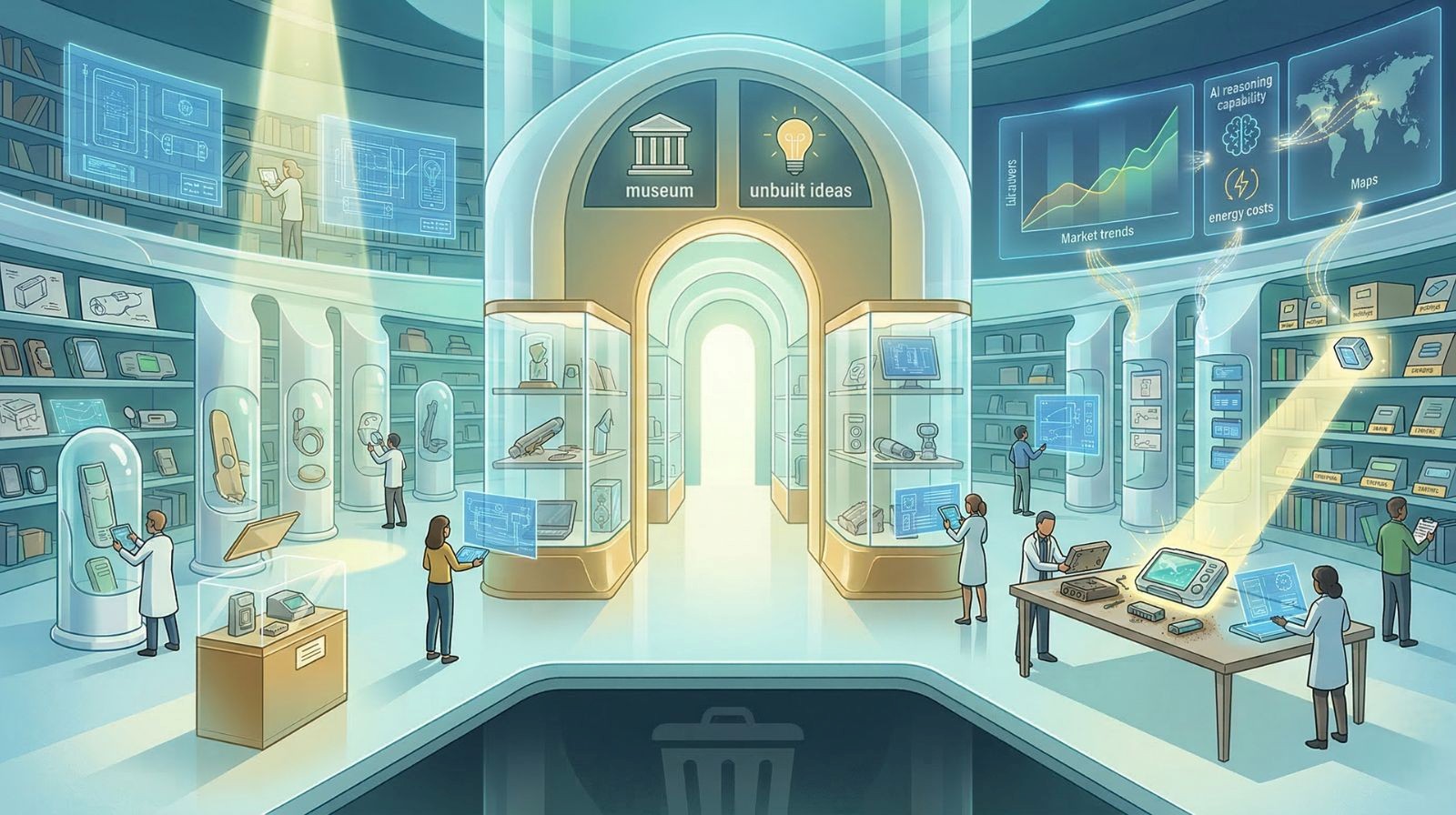
We treat innovation like a birth - a noisy, celebrated arrival of something new. But in the hyper-accelerated market of 2026, the most successful leaders are starting to realize that innovation is actually an act of curation. It’s not about what you build; it’s about the "Museum of Unbuilt Ideas" you’ve accumulated along the way.
The traditional corporate obsession with the launch is a relic of a slower era. When we focus solely on the finished product, we ignore the most valuable asset an organization owns: the Negative Space of their industry.
The Value of Non-Arrivals
In most boardrooms, a project that doesn’t reach the customer is considered a sunk cost. This is a fundamental misunderstanding of intellectual property. The museum" is where your most potent insights live, the prototypes that were too early, the features that were too complex, and the consumer behaviors that were too niche.
If you look at the trajectory of companies that redefine categories, they aren’t just lucky. They are recycling. They possess a high degree of retrospective agility - the ability to reach back into the trash bin of three years ago and realize that a failed experiment in 2023 is the missing puzzle piece for a 2026 breakthrough.
Innovation as a Digestive Process
Think of your company as a biological organism. A healthy organism doesn’t just eat (consume R&D budget); it digests. Most corporate innovation is currently suffering from "indigestion." We move from one pilot to the next without ever extracting the nutrient- the specific why behind the rejection.
To fix this, we need to shift from a launch culture to a metabolic culture. The Post-Mortem is the Product: The data gathered from a rejected idea is often more commercially stable than the hype of a successful one. Hype fades; data on why a user said "no" is a map of a moat.
- The Wait-and-See Portfolio: Instead of "Yes" or "No," the most sophisticated innovators are using "Not Yet." They maintain a dormant layer of 30-40% of their ideas, kept on life support with minimal funding, waiting for a specific market trigger or a shift in AI capability to make them viable.
The Frictionless Fallacy
There is a dangerous trend in modern design toward making everything frictionless. We want the user to think as little as possible. But innovation thrives on productive friction.
If your innovation process is too smooth, you aren’t actually innovating; you’re just optimizing. True breakthroughs usually feel like a mistake at first. They break the existing workflow. They make the legal department nervous. They require the customer to learn a new behavior.
The goal of the modern leader shouldn’t be to remove all friction from the innovation funnel. It should be to identify which friction is waste (bureaucracy) and which friction is signal (the market resisting a change it doesn’t yet understand).
The Architecture of the "Not-Yet"
Building a Museum of Unbuilt Ideas requires a different kind of architectural thinking. It’s not a graveyard; it’s a library.
- Tagging the Failure: Instead of filing a project under "failed," file it under the specific constraint that killed it. Was it a high energy cost? A lack of 5G penetration? A regulatory hurdle?
- The Trigger System: Set digital tripwire alerts. When the price of a certain raw material drops by 20%, or when a new AI model with specific reasoning capabilities is released, the "Museum" should automatically flag which dormant ideas are suddenly viable again.
- The Talent Rotation: Move your best people through the Museum. Let them spend 10% of their time "grave robbing" - looking through old prototypes to see what can be repurposed for current challenges.
Curating the Future
The next time you walk through your office or scroll through your Slack channels, don’t ask, "What are we launching next month?" That’s a commodity question.
Ask: "What is the most brilliant thing we’ve given up on in the last two years, and what would have to change in the world for us to bring it back to life tomorrow?"
The future isn’t just something you build from scratch. Sometimes, it’s something you’ve already built, but you were just too busy looking for success to notice you had already found the answer.