Innovation has a bit of a branding problem. We tend to talk about it in extremes: it’s either a billion-dollar moonshot that changes the world or a series of tiny, almost invisible tweaks to a spreadsheet. In reality, the most successful companies treat innovation like a well-balanced investment portfolio. They know that the biggest risk isn’t failing at a new idea, but staying exactly the same while the market moves on.
As we navigate an era defined by Agentic AI and rapid shifts in consumer behavior, the "all or nothing" approach to new ideas is becoming obsolete. The real secret to staying ahead isn’t just having better ideas- it’s mastering the art of de-risking- lowering the stakes of experimentation so you can move faster and bolder.
The Safe Bet: De-Risking Incremental Innovation
Incremental innovation is the bread and butter of business. It’s the version 2.0 of your software, the more sustainable packaging for your best-seller, or the automation of a back-office process. It’s low-risk by nature, but it often gets bogged down in death by committee.
To de-risk these smaller bets, you need to focus on venture clienting. Instead of spending eighteen months building a solution in-house, partner with a startup to run a three-month pilot. This turns a massive capital expenditure into a manageable operating expense. If it works, you scale; if it doesn’t, you’ve gained valuable data without the "sunk cost" of a failed internal department.
The goal here is time-to-value. By using modular systems and domain-specific language models (DSLMs), companies can now automate niche tasks with high accuracy, ensuring that these small wins actually show up on the P&L by the end of the quarter.
The Bold Move: Making Transformational Innovation Predictable
Transformational innovation is the scary stuff. It’s the project that could cannibalize your existing revenue or require a totally new business model. This is where most boards of directors get nervous and pull the plug.
The way to de-risk a radical idea is to stop treating it like a project and start treating it like a series of uncertainty killers. In the early stages, your job isn’t to build the product; it’s to prove your assumptions wrong as cheaply as possible.
"We spend most of our time trying to prove we’re wrong," says Astro Teller, head of Google’s X. "We run at all the hardest parts of the problem first."
If you’re exploring agentic automation- AI that doesn’t just suggest things but actually executes tasks, don’t start by rebuilding your entire workflow. Build a pre-deployment validation phase where the AI operates in a sandbox. You aren’t risking the business- you’re testing the logic.
Creating a Safe-to-Fail Ecosystem
The biggest risk to innovation is often internal culture. If your team is afraid that a failed pilot will end their career, they will only propose "safe" (read: boring) ideas.
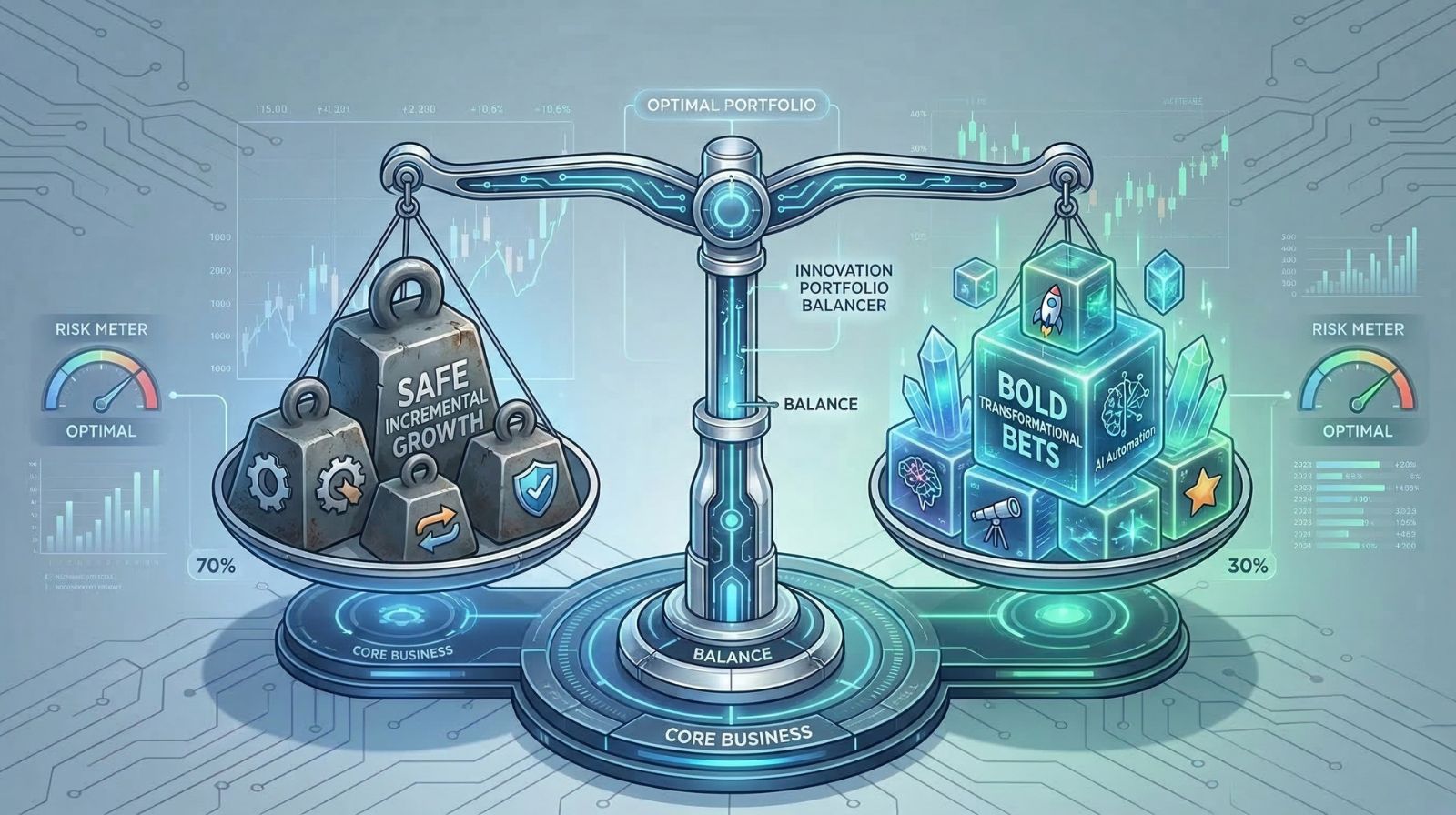
Professional innovators utilize a portfolio approach. They don’t bet the whole farm on one horse. Instead, they allocate:
- 70% of resources to incremental wins (core business).
- 20% to adjacent moves (new markets or products).
- 10% to transformational "bets."
By structuring your budget this way, a failure in the 10% bucket isn’t a catastrophe, it’s the cost of doing business. It’s the R&D insurance policy that prevents you from being the next Kodak.
Execution Over Experimentation
In the current landscape, the bar has moved from Can we do this? to Can we scale this? The era of the endless pilot is over. Whether you are tweaking a product or reinventing a category, the most successful leaders are those who build continuous trust verification into their processes.
De-risking isn’t about avoiding danger; it’s about making sure that when you do take a leap, you have a very clear idea of where the ground is.